Monday, December 2, 2019

2019 Korea Electronics Show (KES2019)


2019 Korea Electronics Show (KES2019)
October 8th ~ 11th, 2019
Coex, Seoul Hall A, B


Categories of Exhibits: Consumer & Home Electronics, IT Convergence, Electronic Parts & Materials, Start-up & R&D, 3D Convergence & Contents, Mobile & Communication, Software & Computing, VR & AR.

2019 Exhibition Expectations:
500+ exhibitors
70,000+ visitors

Exhibition Overview


Organized by the Korean Electronics Association and hosted by the Ministry of Trade, Industry and Energy (MOTIE), KES2019 was first launched in 1969 and celebrating its 50th anniversary. KES2019 is a show which has grown with the Korean electronics industry and is part of its development.

As Japan has restricted exports to Korea, the Korean government has been focusing on the localization of essential parts and components. To be independent in specific markets the government is supporting companies with specific technology; which many exhibited at KES2019.

Entering the exhibition, the first eye-catcher was the booth which was celebrating the 60th year of the electronics industry. This booth informed visitors about the development of the electronics industry in Korea. Providing a timeline with the revolutionary products which brought the industry step by step to today.


There were a number of government agency booths at the exhibition along with city pavilions. The government agencies booths provided researched technology which changed the electronics industry while the city pavilions focused on promoting their community companies.

Even though the government has been assisting the small and medium-sized companies the attraction of the show was fixated on the major players of the industry. Samsung and LG electronics were centered in the middle of the show and were the main attraction.

Pavilions for exhibitors from abroad were provided, which mostly was from East Asia.


In one of the halls was the Smart Biz Expo which was one of the sub-sections of the show related to the smart manufacturing facilities. They showed all different types of products from F&B to consumer products which seemed less related to the KES2019.


Industry


The report by the Korea Electronics Association shows that China is leading the global market with the U.S., Japan and Korea while Vietnam and India are growing rapidly to challenge the leaders in the near future. In 2018, the global market share of electronics for Korea was 8.8% with an average yearly growth rate of 9% since 2013. Within the domestic market, 77.3% of production was electronic components followed by radio comms & radars, computing and customer products.


In 2018, Korea had 19.2% of the global market share of electronic components which is second to China with over 24%. In 2013, Japan was leading the market after China, but within five years Korea has surpassed Japan in the electronic component sectors.
The Radio Comms & Radar sector is dominated by China with over 46% of the global market followed by the US with 20%. Korea still maintains third in market share, but the market share has decreased. The other sectors grew but compared to the global market has not been noticeable.

Opportunities:


Korea has a strong electronics industry which has been developing as one of the top exports that the country can offer. To penetrate the market which is a red ocean it will be time and cost consuming and most importantly require a partner who can effectively promote the company's capabilities.  


If you would like to identify and capitalize on business opportunities in Korea, let IRC Guide your Way!  www.ircconsultingkorea.comJacob at lsh@ircconsultingkorea.com


Tuesday, November 26, 2019

Forecasting the Pork Market in Korea

Forecasting the Pork Market in Korea

Pork is the most popular meat in Korea and the market is huge with 1.4 million tons (US $5.4 Billion) consumed in 2018.   However, the market is changing buffeted by conflicting forces.  This makes forecasting future market opportunities difficult.  The following trends can help shed some light on the future potential for the market.

African Swine Fever (ASF) is a serious viral disease afflicting pigs that can spread very rapidly among the pig population.  Market insiders watched carefully as ASF spread across Asia and approached Korea.  ASF first appeared in China in August 2018 and then reached North Korea in May 2019. The first cases were detected in South Korea in September 2019.

Korean pork importers anticipated the impact of ASF and built up stocks expecting that the disease would result in a significant culling of the pork population and thus driving up prices.  In China, pork prices rose 40% after ASF hit the country.  However, in Korea, when ASF finally arrived, the market behaved exactly the opposite of their forecasts and pork prices have fallen.  How could market insiders be so wrong in their forecasts?

Pork Remains the Most Important Meat Source

Pork is the most popular meat among Korean consumers followed by chicken and beef. Pork consumption per person has been increasing steadily from 5 kg annually in the 1970’s to 25 kg in 2018. However, beef and chicken consumption are currently growing more rapidly than pork. Meat consumption has grown at 4% CAGR over the period 2008-2017. This breaks down as follows: beef: 5%; chicken 4%; pork 3%.

Annual Meat Consumption per Capita:  


Unit: Kg
Source: Korea Meat Trade Association

Consumers Shift Away from Pork

As Korean consumers' incomes grow, more and more are looking to beef which is considered a premium meat. Also, chicken is considered a healthier alternative to pork. A common assumption in Korea is that white meat such as chicken and duck is healthier than red meat.

Another important change among consumers is that consumers are increasingly reluctant to cook pork at home because of the mess and smell.  The most popular cut is pork belly which is considered the tastiest (due to the fat layers) and most compatible with Korean barbecue cooking methods. However, when pork is barbecued, the fat splatters all around the cooking area.  Also, the residual odor from cooking pork remains for many days.  Opening windows to reduce the odor is unwelcome in the cold Korean winters. 

Korean consumers have been migrating to healthier and cleaner dishes in recent years. Furthermore, consumers have responded to the arrival of ASF by reducing consumption of pork out of fear of contamination.  Therefore, pork prices are responding to reduction in demand rather than shortage of supply.

Premium Pork

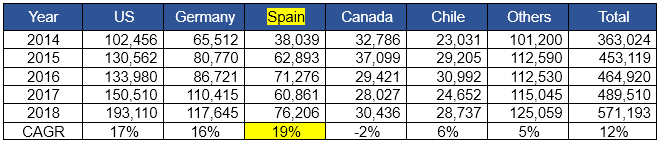
Over the past 10 years, consistent with the shift towards quality, different species of pork have been introduced to the market as premium pork. For example, Iberico from Spain, Jeju Black pigs from Jeju Island and Mangalica from Hungary.

Among the newly introduced species, Jeju black pigs and Iberico from Spain have achieved big success. The success of Iberico has led to growth of the pork from Spain.


Pork Imports by Country by Value


Unit: USD 1,000


Pork Imports by Country by Volume


Unit: Tons
Source: Korea Customs Office       

When looking at entering the Korean market, it is risky to make assumptions based on experience in other markets.  It is critical to understand Korea's specific market dynamics and adjust your strategy accordingly.


If you would like to identify and capitalize on business opportunities in Korea, let IRC Guide your Way!  www.ircconsultingkorea.com,


Wednesday, March 6, 2019

Chinese Dust:

As children, we are taught at an early age not to stare at the sun.  Youth of today could be excused for their skepticism.  In Seoul, in early March 2019, even at midday, staring at the sun (if you can see it at all), poses little danger to the retina. Dust from the Gobi Desert has delivered a fine, yellow tint to the spring skies in Korea for centuries.  In the past decades, as China industrialized, the factories along the East coast have emitted pollutants into the atmosphere which have bonded with the yellow dust and delivered a noxious health risk to the Korean peninsula.  While I have titled this piece 'Chinese Dust', political correctness now dictates that it be called 'fine dust' to disassociate it from China, an increasingly important political stakeholder. Nevertheless, these Chinese chemical imports are inflicting a tremendous cost on the Korean population.  Hospital outpatient visits spike on highly polluted days, instances of pneumonia and chronical lung suffers are growing.  Even heart disease grown is attributed to the dust.
Korea has implemented multiple responses to this problem.  Probably the most meaningful is political efforts to establish cooperative efforts with China and Japan to address the problem. The majority of the problem comes from China so the major solution must be found there.  Korean NGOs have established programs to plant trees in the Gobi Desert to try to stem the relentless expansion of the arid region.
Closer to home, the government has turned its attention to local contributors to the problem. For more than a decade, natural gas has been applied to home heating as well as fueling all city buses and taxis. Recently, tour bus drivers were instructed not to idle their engines when waiting for passengers. Korea has established a goal to convert all vehicles to environmentally friendly alternatives (e.g. we will produce 6.2 million hydrogen cars by 2040). The Ministry of Trade, Industry and Energy has announced that it will suspend operation of 'old' coal fired power plants.  The first (unsuccessful) attempt to seed clouds to promote rain was implemented in January 2019.
In the meantime, the government broadcasts warnings about dangerously high levels of pollutants almost on a daily basis.  Virtually everyone on the streets is seen wearing a mask.  The market for air purifiers has tripled since 2016.  There is a discernible migration of families to rural locations down country (Jeju island being particularly attractive) or even overseas.
The challenge appears daunting and politically complicated but efforts on many fronts must be implemented simultaneously if Seoul is to again see the sun.


Peter Underwood, IRC Consulting Managing Partner. 


Monday, March 4, 2019

2019 March COEX Exhibition Schedule


Korea CES - Korea Electronics IT Industry Convergence Exhibition

Korea Electronics IT Industry Convergence Exhibition

January 29  ~ 31, 2019
Dongdaemoon Design Plaza

The Korea Electronics IT Industry Convergence Exhibition, was inspired by the US CES show in Las Vegas (therefore known as "Korea CES"). This exhibition was organized by the Ministry of Science and ICT, the Ministry of Trade, Industry and Energy and the Ministry of SMEs and Startups at very short notice only about 9 days before it opened.  Local electronic players such as Samsung, LG, SKT, Naver and Coway were pressed to join as exhibitors. The primary focus was for the public and startups to experience new technology and get a taste of the nation's potential. Held at Dongdaemoon Design Plaza in the center of Seoul, it was open to the public free of charge. Korean President Moon Jae-in visited the exhibition to give it gravitas and to encourage the companies.


The exhibition displayed many interesting new technologies such as AI, VR, fin-tech, health tech and electronic applications in many other industries. We found LG’s The Wall 219” 6K Micro LED display the most interesting because it seemed so real.


Opportunities:

The media heavily criticized the exhibition.  First, it was focused on the public rather than industry buyers so there was no commercial value to the exhibitors.  Second, the very short time to prepare was insufficient to develop superior exhibits or to promote the event to visitors.

Should the event be repeated in the future, it would be a good opportunity for foreign companies wishing to introduce or promote their brands to consumers in Korea.  Future events would probably be less rushed and would allow more time for preparation of eye-popping displays.

If you would like to identify and capitalize on business opportunities in Korea, let IRC Guide your Way!  www.ircconsultingkorea.com,


Education, Key of the Future - EDUTEC

EDUTEC
January 16rd ~ 18th, 2019
COEX Hall A & B, Seoul Korea

http://www.educationkorea.kr/english/


Exhibits: EdTech·Education Trend, Smart Schools, Educational Contents, Vocational Education & School·Institute Promotion, Educational Environmental Facilities, Culture · Arts · Physical Education

2018 Exhibitions Results
   215 exhibitors
   33,362 visitors

EDUTEC was opened by VIP educators, both local and from overseas. Compared to past events related to education, EDUTEC attracted many more visitors and exhibitors. The exhibition was divided into two halls A and B. A Hall was primarily about future educational content, education environment, smart school, coding/AI/VR. B hall was more related to actual education and seminars for teachers and parents.


   Coding:

Coding education was a 'hot' subject and there were many exhibitors with coding education programs.

 
   VR Education:

VR exhibitors drew both teachers and students and accounted for a significant number of exhibitors.  Experiential opportunities drew many visitors. VR education also supported job interview preparation and other sectors outside of student education.

 
Other exhibitors also provided hands-on learning experiences and attracted many visitors.

 
There were three seminar rooms providing information to visitors featuring a range of topics from general information to specific educational opportunities.

   Opportunities:

Most of the exhibitors were local entities and the visitors were domestic teachers, students and parents.  While there were few international exhibitors, EDUTEC would be a good opportunity to obtain wide exposure to educational products and services.  International exhibitors would need to be careful to pitch their presentation to a Korean audience, information would have to be presented in Korean and experiential activities would draw the largest crowds.


If you would like to identify and capitalize on business opportunities in Korea, let IRC Guide your Way!  www.ircconsultingkorea.comJacob at lsh@ircconsultingkorea.com


Sunday, March 3, 2019

WORLD FRANCHISE EXPO 2019

World Franchise Expo 2019
January 3rd ~ 5th, 2019
COEX Seoul Korea


The 'World Franchise Expo (WFE)' is the most extensive, ongoing franchise industry exhibition in Korea. WFE exhibits biannually, once at COEX in Seoul and once at KINTEX in Gyeonggi province.  This year was the 50th WFE.

Categories: Franchises were presented in five categories:
   Foodservice franchises
   Non-foodservice franchises
   Retail for franchises
   Service for franchises
   Facilities for franchises

In 2018, the WFE attracted
   200 exhibitors
   37,628 visitors (More than 40% from Seoul)


Entrance to the 50th World Franchise Expo


The primary target for the show is individuals interested in opening a franchise. WFE holds seminars to explain strategies to successfully start a franchise and provide other crucial information regarding the franchise industry.  Compared to other exhibitions we have attended, the exhibitors were very enthusiastic, aggressively introducing their service/products on the first day of WFE.  Listening to the exhibitors, we felt the urge to start the perfect franchise business.

   Foodservice Franchises

Foodservice franchises were most widely represented at the WFE. There were all different types of fast-food businesses such as pizza, street-food, noodles and seafood, and Korean barbeque.  Even though the café market in Korea appears over-saturated, coffee focused franchises were attracting attendees.


   Entertainment Franchises

The non-foodservice franchises were primarily focused on entertainment such as PC bangs (Cyber-café), board game cafés and other entertainment franchises.  Many of these franchises also provided food to boost revenue.  One interesting concept was the study café which provides a small space to study and rest.  


   Retail Franchises

Retail franchises were targeting new businesses and franchise headquarters to extend their sales. 


   Services for Franchises

Services were mostly related to real estate. There was an agency that not only provides franchise consulting but has partnerships with franchisees to provide a franchise experience to allow potential franchisees to experience operating a franchise before making an actual investment or startup. 


   Facilities for Franchises

There were a few facility related booths such as Samsung seeking local distributors for air conditioning and similar products.  


   One-Person Business

Walking the show and observing what booths attracted the visitors, it appears that a major trend was towards self-employment opportunities. With the rise in unemployment (driven by a sudden increase in minimum wage and stricter employment laws), self-employment opportunities seemed to have a much stronger appeal than in past years.


  Challenges & Opportunities:


Even though the exhibition is called the World Franchise Expo, it seems to be very locally focused.  The webpage was entirely in Korea with no English introduction. Also, Korean franchises generate their income not from royalties but by adding a margin to products or profit generating logistics services. The World Franchise Expo will help to understand the franchise environment in Korea and provide an opportunity to meet a potential Korea business partner. 

If you would like to identify and capitalize on business opportunities in Korea, let IRC Guide your Way!  www.ircconsultingkorea.com,